RGA Outgassing and Cleanliness Qualification Services
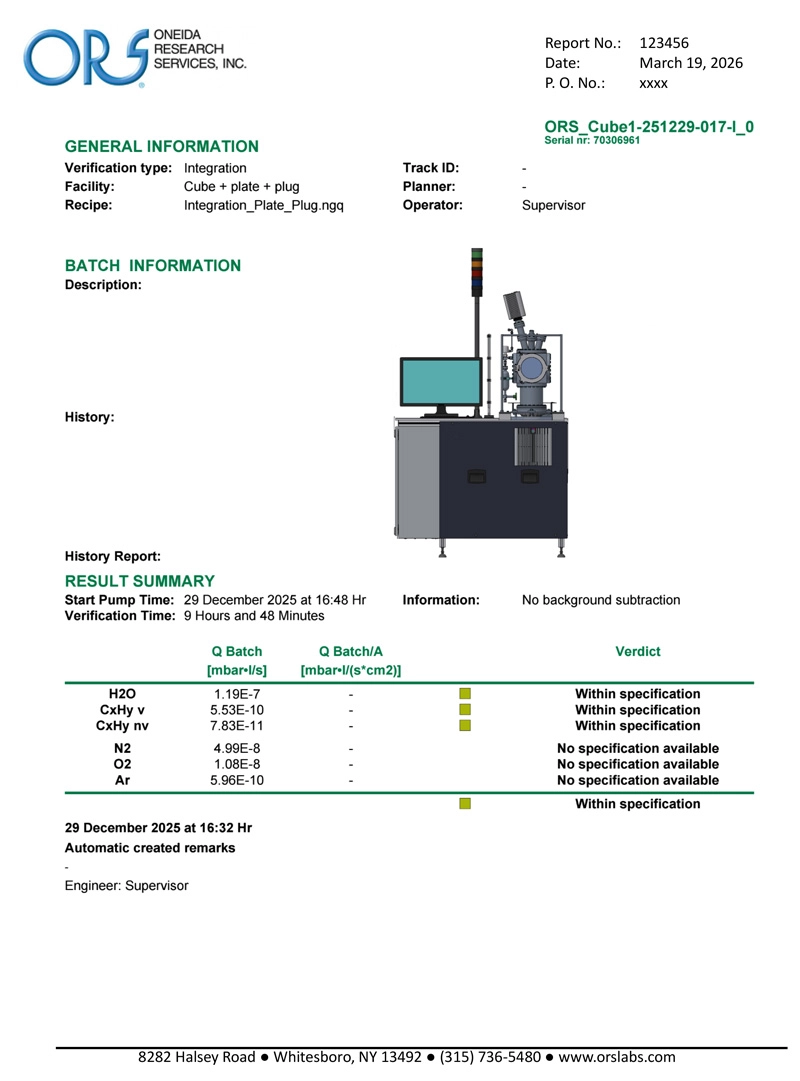
Oneida Research Services (ORS) now offers high-sensitivity residual gas analysis to confirm cleanliness of vacuum-sensitive components and assemblies. A highly sensitive RGA testing platform is configured for outgassing specifications as specified in cleanliness verification standard ASML GSA 07 2221, Grade 2. This newly installed RGA system can collect time-resolved mass spectra, total pressure traces and quantify outgassing rates for volatile (45-100 amu) and non-volatiles (101-200 amu) at room temperature.
Key Capabilities and Technical Highlights
- Full mass range analysis — Continuous mass spectral acquisition across 1–200 amu to detect light gases (H₂, He), common volatiles (H₂O, N₂, O₂, Ar), and higher mass organics.
- Synchronized multichannel acquisition — Simultaneous logging of mass spectra, total chamber pressure, and sample temperature at user specified sampling rates for rigorous time resolved interpretation.
- Traceable calibration and validation — Instrument validation and gas-specific calibration routines are supported and documented to maintain measurement integrity and repeatability.
Standards, Traceability, and Quality Controls
- ASML Standard — ORS’ RGA system configuration strictly follows specifications detailed in ASML GSA 07 2221, Grade 2 (RGA verification) and produces reports compatible with industry qualification workflows for vacuum cleanliness and outgassing.
- Operator training and documentation — All RGA verification operations are performed by trained personnel under documented recipes and event logs to support auditability.
- ISO 7 certified laboratory environment — The RGA verification is carried out in ISO 7 clean laboratory, ensuring controlled particulate and cleanliness conditions during sample handling and instrument operation.
- Packaging for ready to ship samples — After RGA verification, ORS can pack samples in ESD moisture barrier vacuum or UHP Nitrogen sealing (up to 24″ diameter) to ensure cleanliness.
- Calibration and validation programs — Routine gas-specific calibrations and periodic background scans are performed and recorded to maintain traceability and reproducibility.
Measurement Approach and Data Products
- Screening and qualification workflow — Initial RGA screening identifies whether organic species are present; conditional follow-on analyses (GC/MS, IVA) are recommended only when identification is required, reducing unnecessary cost.
- Report package — A detailed standard reporting that includes time series plots, tabulated outgassing rates, pass/fail assessment against customer limits.
Typical Use Cases and Applications
- Semiconductor and EUV component qualification — Screening for volatile contamination that can impact lithography and vacuum processes.
- Aerospace and defense hardware — Verification of materials and coatings for vacuum compatibility and long-term stability. Screening for outgassing that could potentially coat sensitive surfaces like mirrors or lenses.
- Medical device components — Assessment of sterilization and packaging processes for residual volatiles.
- Supplier qualification and incoming inspection — Rapid screening to support supply chain acceptance and lot release.
Why ORS RGA Services
- Decades of regulated testing experience — ORS brings four decades of MIL-STD and high-reliability testing expertise to contamination control and qualification.
- Fit-for-purpose instrumentation — The RGA system is configured for sensitive, repeatable qualification scans with integrated calibration and validation workflows.
- Cost effective, tiered testing strategy — RGA screening identifies when higher resolution identification (GC/MS) is warranted, minimizing unnecessary expense while preserving technical rigor.
- Actionable technical insight — ORS can provide interpretive recommendations to support material selection, process changes, or further analytical follow-up.
Next Steps and Contact
To request a quote or discuss a tailored qualification plan, please provide: Part description, target acceptance limits, and required reporting format. ORS will respond with a proposed scope, timeline, and pricing, and can advise on conditional follow-on analyses (GC/MS or IVA) where identification of organics is indicated.
Contact: Krista Vivenzo
Email: Kvivenzo@orslabs.com
Phone: (315) 736-5480 ext. 2231